Imaging Performances of a Compact Interferometer
A compact interferometer like SOLARNET (3 telescopes of
Ø350 mm on a 1 meter baseline) is comparable to a single dish
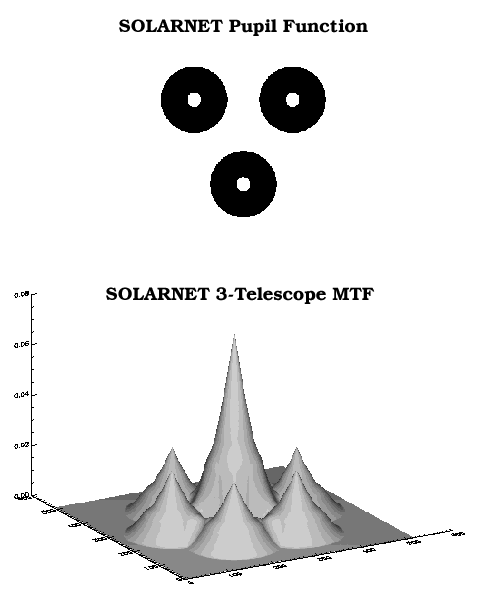
telescope in many respects since the Modulation Transfer Function
(MTF) covers all the spatial frequencies of the image. The
repartition is not excellent for intermediate frequencies since deeps
up to 7.3% can be noticed. Nevertheless high frequencies are well
represented and a simple deconvolution (or even Wiener filtering)
allows to recover totally the image information. The secondary peaks
are one third the central peak amplitude which explains the excellent
imaging capabilities of the interferometer.
 SOLARNET
configuration and MTF. Note the valley between the secondary peaks
(12.5%) and the deeps between the peaks (7.3 % minimum) although the
spatial frequencies coverage is similar to a single dish telescope
since all spatial frequencies are registered
instantaneously.
SOLARNET
configuration and MTF. Note the valley between the secondary peaks
(12.5%) and the deeps between the peaks (7.3 % minimum) although the
spatial frequencies coverage is similar to a single dish telescope
since all spatial frequencies are registered
instantaneously.
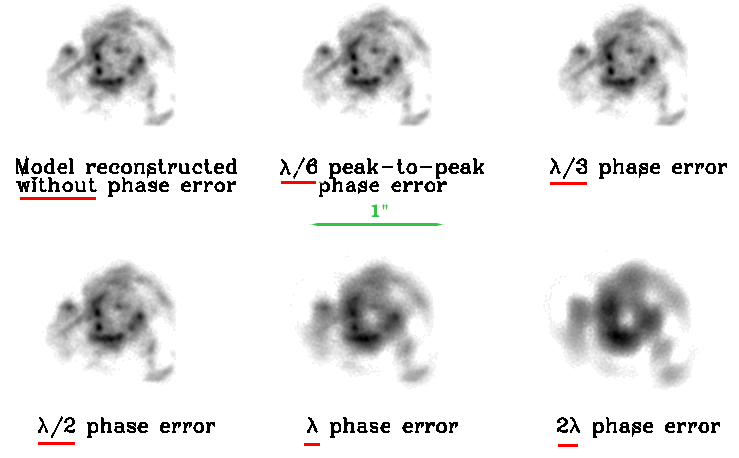
Image reconstruction of a complex and extended object with
SOLARNET. Note the excellent reconstruction capabilities (both in
terms of spatial resolution and intensities) when the phase errors
are below 1/6th of the wavelength. This indicates the minimum
requirements to achieve with the cophasing system. These images
result from the simple deconvolution of a single exposure made with
SOLARNET: a SOLARNET 2D-interferogram directly gives a solar
image.