Our results of the cophasing of two telescopes both in laboratory and on the sky have been published and these papers can be read in html directly on the web (Damé et al., 1997, [1] Damé, 1997, [2]) or can be downloaded in pdf format if preferred ([1], proc_THEMIS.pdf (352 Ko), [2] proc_ESA-IAAA.pdf (1 Mo)).
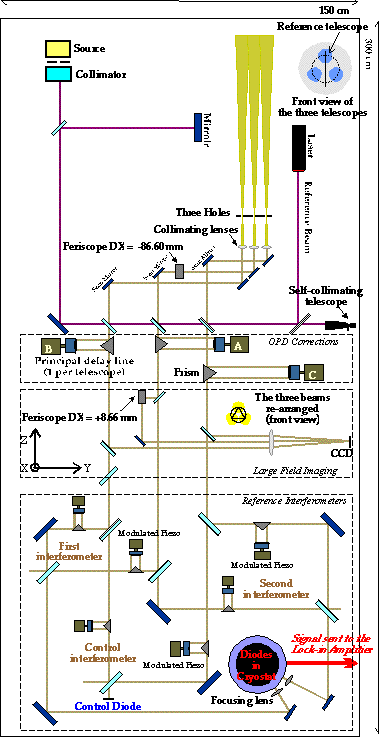
Our new breadboard currently under realization is a complete imaging interferometer with three telescoes cophased (optical path delay adjustements by retroreflectors) and coaligned (fine pointing of the beams with fast active mirrors). The schematic layout of the setup under realization is given hereafeter. The compromize of the laboratory breadboard study is the use of small refractors (Ø60 mm, f=800 mm) instead of the Ø350 mm telescopes of SOLARNET. But magnifications and sizes are otherwise preserved.
The major advantage of the new Three Telescopes (3T) setup is to provide a true imaging channel where an image can be formed and analysed, directly or by any other mean (double monochromator, etc.). Such a breadboard will allow to test acquisition and control procedures of the 3T system but also the imaging performances to expect. It is also the essential step to elaborate tolerances for the space qualified engineering breadboard which realization is expected (micro-optics for the reference interferometers) in 99.
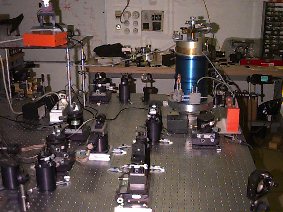
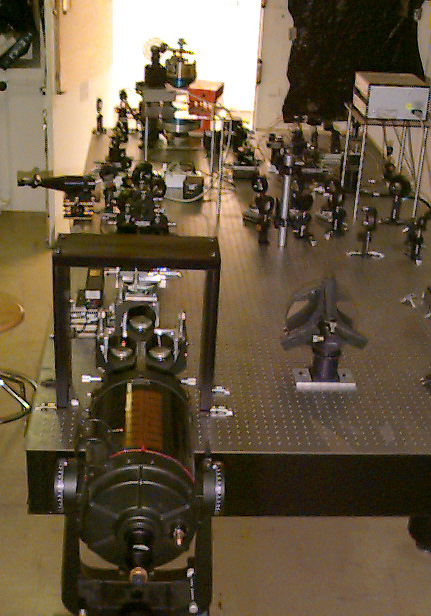
Global view of the new interferometry table (1.5 x 3 m) used for the three telescopes breadboard seen from the source (Hamamatsu Arc Lamp or Phillips Halogen depending of studies). Notice the three refractors (Ganymède, Ø60 mm, f=800 mm) which are the entrance pupil. The Celestron 8 serve as the source collimator for the three refractors.
Detail of the three refractors mounting: 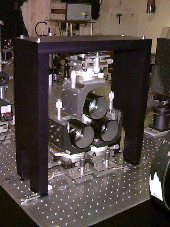
Field selection and reference system after the entrance refractors. Note that the active mirrors for fine pointing are not yet implemented.
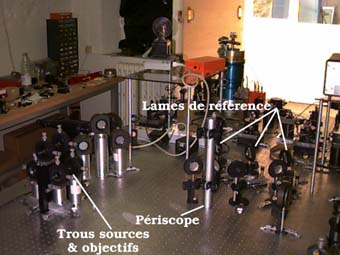
View of interferometers 2 & 3 during completion of the three telescopes breadboard. A simple operation procedure allows to use the interferometer either with the reference source (control Mach-Zehnder) in a two telescopes setup or in the full imaging setup at three telescopes. In this last case, 2 reference interferometers are active to find and control the phase (OPD between telescopes) while the third one control the quality of the overall process.
|
View of two of the three Reference Interferometers |
|
|
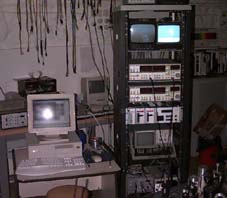
Synchornous detections and control electronics |
|
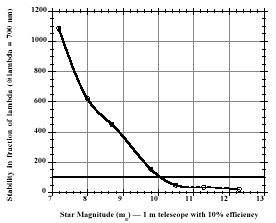
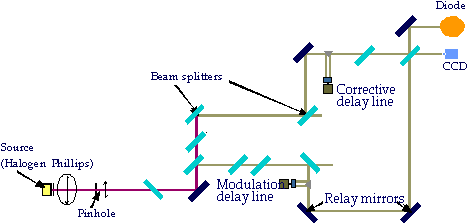
Using a part of the new three telescopes breadboard (mainly the reference white light source control part), we investigated for ESA (Optical Aperture Synthesis Technologies II contract, leaded by MATRA), the limit magnitude of a servo control to l/100 of a cophased interferometer. The performance of our double synchronous detection technique allows to say that magnitude 10 stars can be envisaged to phase meter-class telescopes, yet at l/100. If this can be done on stars of magnitude 10, one can easilly imagine what can be done on the Sun surface...!!!
|
|
More details on this study can be found in a recent paper, directly readable on the web in html: Damé et al., CNES ICSO'97 International Conference on Space Optics, Toulouse, FRANCE, December 2-4, 1997. A pdf copy of this document [icso97.pdf (494 Ko)] is also available for download.
|
|
Results on the phase measure sensitivity to pointing errors by September |
|